
The Outrage at Etaples
Private Reginald Percy Gage

Private Reginald Percy Gage
Born 1895 London, England
Died 1967 Hawaii
Enlisted in the 116th Battalion
Served as an Orderly in the CAMC
Missionary with the Seventh Day Adventist Church
Veterans Counsellor
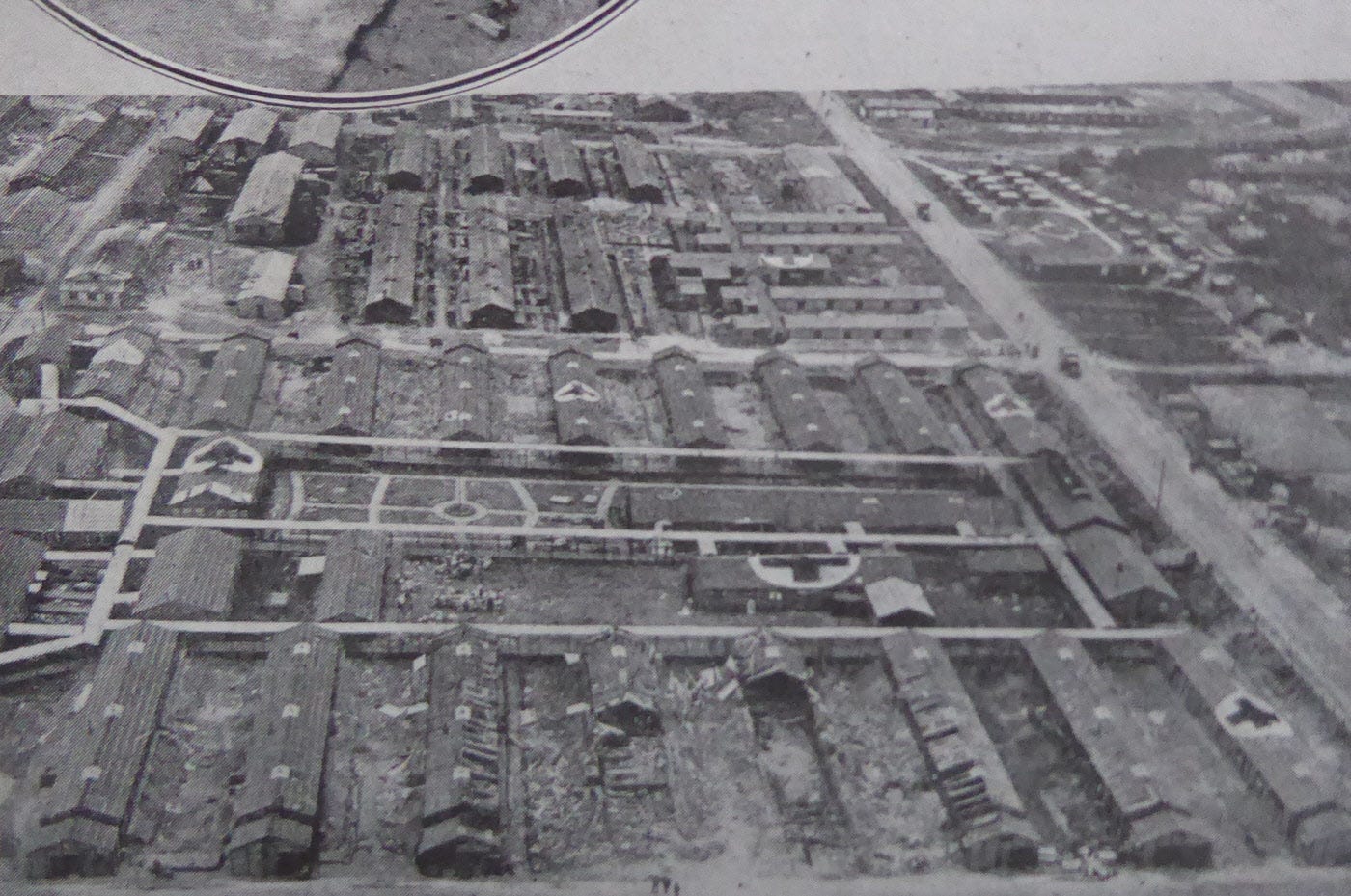
It was a perfect Spring night, calm and clear with the moonlight illuminating the seaside hospital camp. The patients, those fit and able to attend, along with their caregivers, the nurses, orderlies, and doctors were making their way back from a concert just attended. They were returning to their quarters at the No. 1 Canadian General Hospital at Etaples. Most patients were already sound asleep, giving their broken bodies some well needed rest and chance to heal. It was 10 pm on the 19th of May 1918.
It started with a faint hum blowing in from the sea. Some heard the clatter, but most paid no attention to it. The Camiers Aerodrome was located nearby with aircrafts regularly coming and going. Lest it all, the sound from the sea grew louder, louder, and progressively louder. Still, few showed any alarm, care or concern. They were in a hospital camp, a facility created to nurse the sick and heal the wounded, situated far from the unforgiving brutality of the front lines. They felt safe. Secure. They were so wrong.
The stillness of the night ended by the sudden, treacherous, and violent bypassing of a squadron of German bombers screaming by overhead. Within seconds, a succession of explosions tore up the first row of buildings situated along the western edge of the compound. High explosive shells of varying calibers smashed the structures, easily passing through the flimsy canvas and detonating amongst the sleeping men. The first volley was followed by a second. Here incendiary devices turned the formerly serene setting into a fiery hellscape. The patients and medical staff were helpless as the torrent of flame detonated amongst them. They called it an outrage…it would prove to be far worse.
The leading squadron consisted of between eight and twelve German fighters and bombers. The fighters followed the bombers, making sure to aim their weapons at anyone and anything seen moving…whether it be those fighting for their lives or those fighting to save them. After the initial first wave came a second and then a third and then a fourth…each using the fires as purposeful targets. For two hours, the Teutonic terrorists battered the unguarded and exposed hospital with murderous intent until their payloads and ammunition cartridges were empty.
The date of the outrage: May 19th, 1918. Students of the war will recognize that this date coincides with another key timeline in the annals of the Great War; The German Kaiserschlacht, also known as The Kaiser’s Battle. It is called The Spring Offensive in the west. The operation was launched two months prior, on March 21st when the Axis powers launched a massive surprise attack, coordinating their air power, infantry divisions, cavalry units, and artillery united in a coordinated attack where they knocked a forty-kilometer-wide dent into the Allied lines along the Somme sector. The first two attacks, Operations Michael and Georgette, inflicted over 360,000 casualties on the British and French. As the lights in the sleeping quarters and patient wards of the Etaples Hospital Camp were being put out the men whose lives were only recently upended by the Germans would go through it one more time and for many of them, one last time.
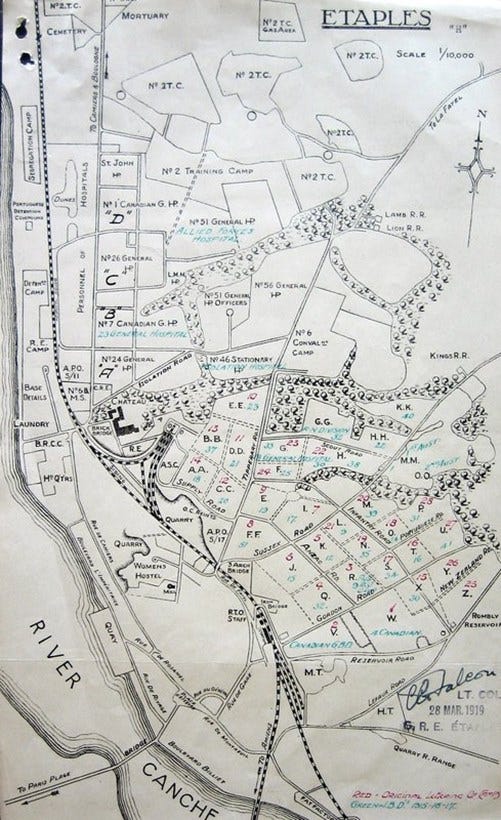
The hospitals at Etaples were neither new nor unfamiliar to the enemy. The facility opened on May 31, 1915, and over the next three years grew to support over 22,000 patients and upwards of 100,000 people. By 1918, the facility boasted twenty-two hospitals caring for soldiers of all nationalities, including Canadian, British, Australian, New Zealand and French. A birds’ eye view of the area would showcase more than four hundred tents and huts spread over the wide area located just north of Etaples huddled all along the channel coast. The compound was sprawling with stories about it well documented in the newspapers and publications of the time.
The two Canadian hospitals onsite were the No. 1 McGill General Hospital and No. 7 Queens General Hospital. They were staffed by students, doctors, and surgeons from the medical schools of each respective University. As the area included only hospitals and medical care facilities, the commanders did not bother to enact defensive measures protecting the facilities against aerial attack. They did place large red crosses on the tops of their rooftops to eliminate any chance of mistaken identity by the odd clueless Hun airman (or 50 of them) unaware of the noble purpose of the facility. They were confident in their trust of their enemy as the traditional rules of war were quite clear and murdering helpless, bedridden patients was strictly prohibited.
In the Spring of 1918, these conventions proved to be worthless. The conflict was in its fifth year, and it was not going well for the fatherland. A British naval blockade of the continent caused devastating food shortages in Germany and despite their initial successes, the Axis powers suffered massive losses in men and material with few tangible gains. Oh, there was another thing that kept the Germans from sleeping well at night. 600 kilometers down the coast, over a million fit and well-fed American soldiers were disembarking from their troopships at Saint Nazaire. With each new division of Yanks that landed on the continent, the level of panic amongst the German General Staff increased. Day after day the docks at Calais, Boulogne-Sur-Mer, Dieppe, Brest, and Saint Nazaire welcomed another boatload of fresh replacement troops. This constant deployment of new fresh troops was something the German Supreme Command could not match. However, they knew that if they did not do something and quick, their chances of avoiding a colossal defeat in France and Belgium would be erased. Thus, they resorted to a series of extreme ideas and tactics. They ramped up unrestricted warfare in the seas, enacted scorched earth tactics in the occupied French and Belgian zones and employed unrestrained bombings campaigns in the air including bombing everything from cities to defenceless hospitals.
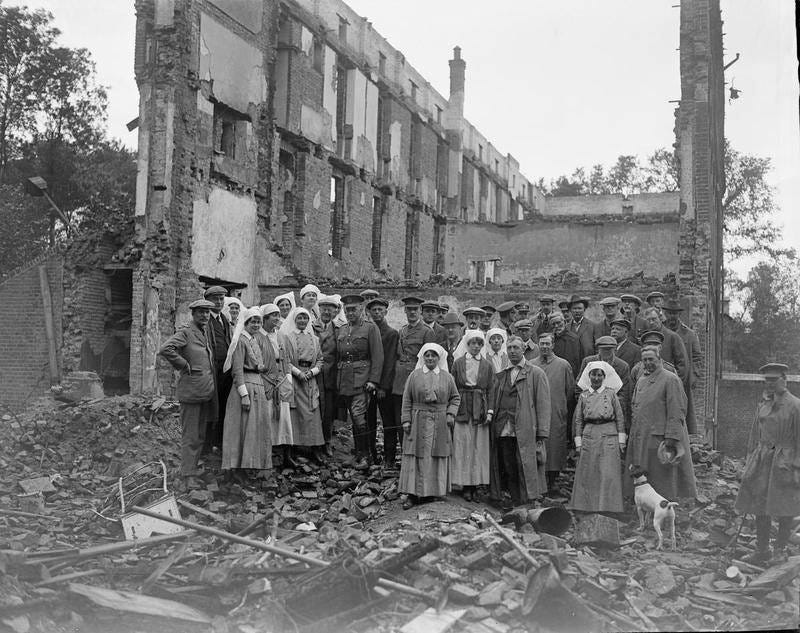
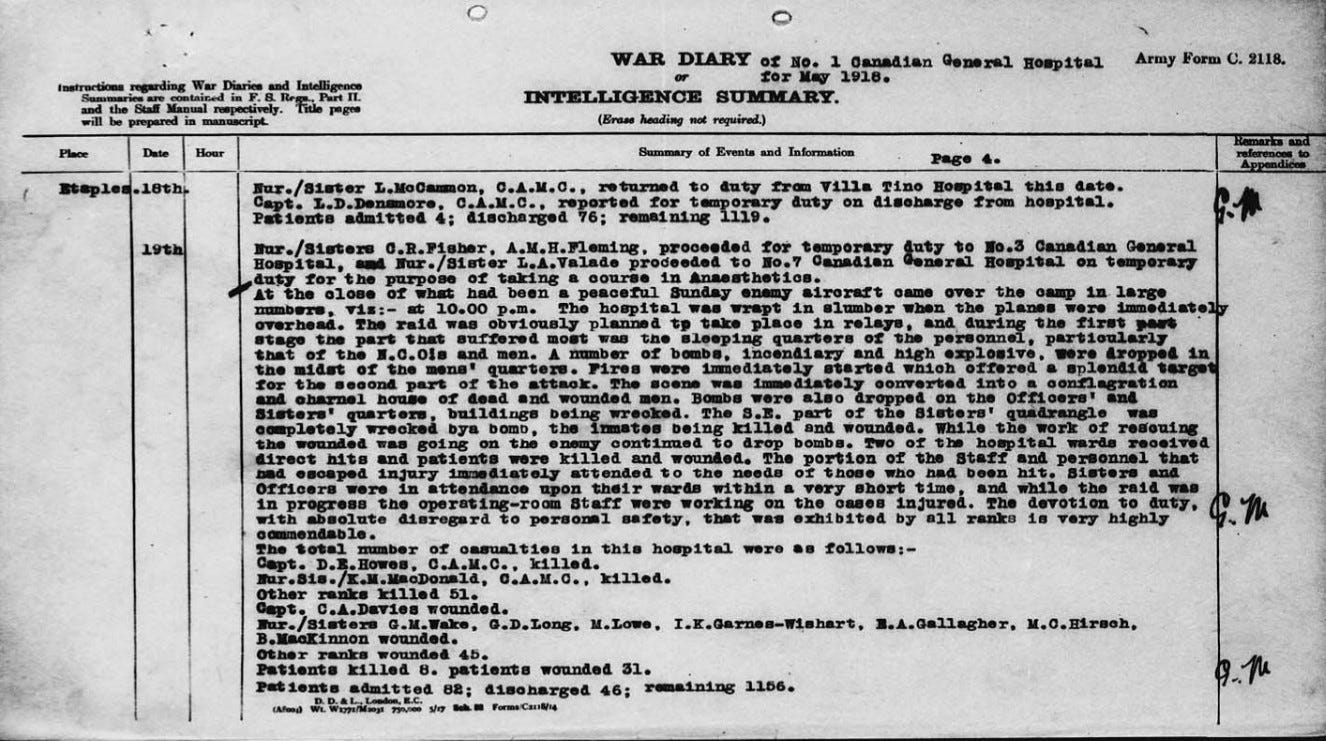
The attack on the hospitals in Etaples resulted in grave damage and significant human loss. One hospital ward on site received a direct hit, six others destroyed, and three partially damaged. While the records detailing the losses vary, in his book Life Savers and Body Snatchers; Medical Care and the Struggle for Survival in the Great War, the late Tim Cook indicates that 66 Canadians were killed, including three nurses and one medical officer. Another 73 were wounded. The Official Diary Etaples Hospital Camp lists the total number of casualties (from all nations) at 169 killed and 622 wounded (27 officers, 27 nurses and 584 other ranks).
To best understand the extent of the carnage inflicted upon the camp, it is best to consult contemporary news reports. These stories include anecdotal references from the news reporters who were there. In one instance, the Toronto Star reported that one of the first buildings hit housed the medical orderlies. The report detailed that the sleeping men received a direct hit and were ‘blown to bits.’ Many of the patients were trapped in the inferno that followed and died a most horrific death. For those unaware, orderlies tended to be over-aged soldiers deemed unfit to serve in the front lines. They were often veterans of the Boer war and so dedicated to service to their countries that they lied about their ages. Once they arrived in England and France, they were transferred to the Canadian Army Medical Corp to serve as orderlies, helping care for wounded soldiers, washing their wounds, replacing bandages, or helping feed and dress the men.
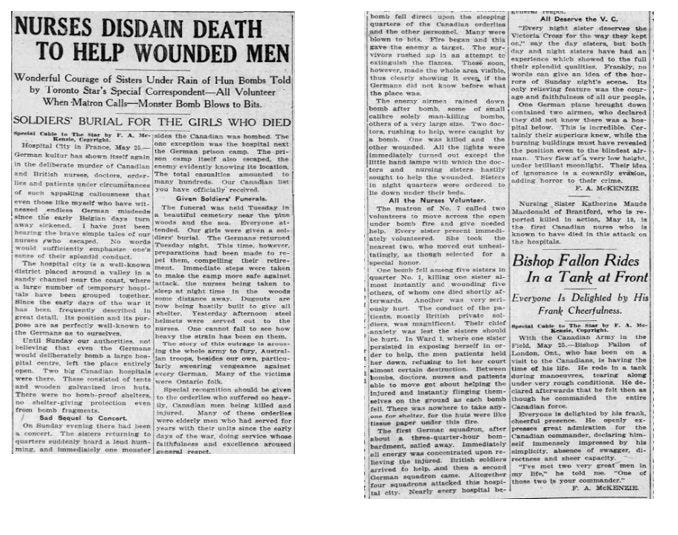
Headlines such as “German Savagery at its’ Worst,” “The Hospital Outrage,” “German Night Raiders Rain Death on Sanctuary of British Wounded” and “A Deliberate Outrage, Germans Machine Gunning Hospitals” screamed across the mastheads of leading global publications. Contemporary reports also revealed how the German fighter pilots flew close so to the ground they could gun down any person who attempted to help save those trapped in the burning or destroyed buildings.
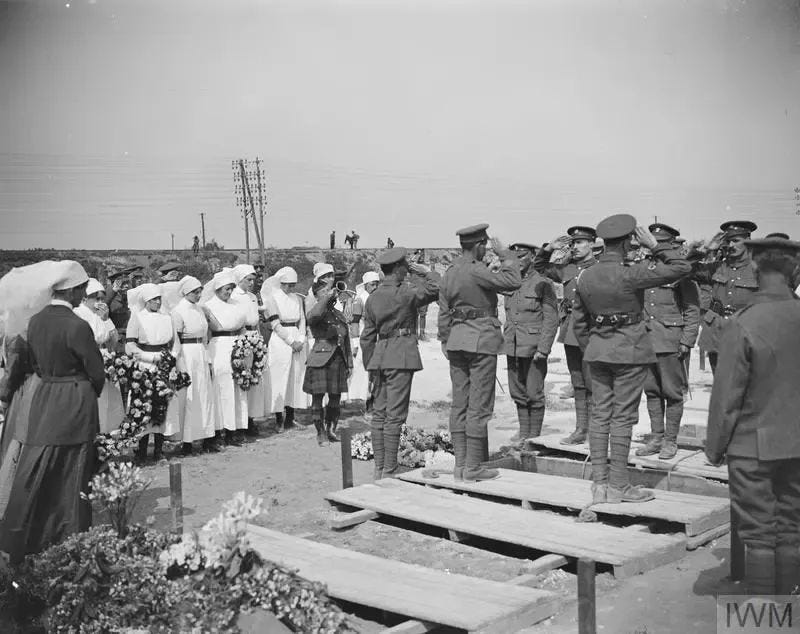
The newspapers did not forget to highlight the displays of courage and bravery exhibited by the female nursing staff. In one account, an urgent call for help was made and every nurse in one ward immediately volunteered to assist. The account then detailed how a bomb fell amongst a group of nurses who were moving between buildings. Nursing Sister Katherine Maud MacDonald from Brampton, Ontario received a fatal shrapnel wound that severed her femoral artery. Nursing Sister Margaret Ann Lowe from Binscarth, Manitoba died after suffering a skull fracture and severe chest wound. Her fellow associate, Nursing Sister Gladys Maude Mary Wake from Brantford ON also succumbed to her injuries. All three were buried with honours at the Etaples Military Cemetery.
However, one of the most horrific anecdotes from the night attack is included in Cook’s book. He noted that many of the soldiers had compound fractures from the fighting in the Michael and Georgette offensives. Their smashed limbs were caused by high calibre shells exploding too close to their bodies. To aid in their recovery, they were strapped down to their cots, making them immobile in the hopes that it assisted in a speedy recovery. When the incendiary bombs set their quarters aflame, a number of men burned to death, strapped, and trapped and unable to escape the inferno.
From one of the first buildings hit by the German onslaught, we find a connection to the 116th Battalion. Private Reginald Percy Gage, a 116th Battalion original, served as an orderly with the CAMC and was stationed at the McGill Hospital at Etaples. Prior to the war he was a student in the Oshawa Missionary Academy (aka the Buena Vista Academy). This school was run by the Seventh Day Adventists, a religious sect oriented to faith, scripture and service and considered war as ‘the epitome of evil.’ While the reasons for his reassignment from a ‘fighting’ unit like the 116th to an orderly with the CAMC is unclear, it was the perfect role for the missionary soldier. As an orderly, he would focus on saving lives and making them more comfortable in their time of need. Gage was listed as one of the 73 Canadians wounded in the attack. He received shrapnel wounds to his scalp, shoulder, arm, and buttock.
The attack on the hospital complex at Etaples was not the end of Germany’s oddly ironic determination to truly give their enemy something to fight for. They followed up the attack on the hospitals at Etaples with three more attacks in the waning days of May 1918 and one-upped the atrocity by sinking Llandovery Castle, a Canadian hospital ship off the coast of Ireland on the evening of June 27th, 1918. As breaking the rules of war, once again, was not enough, the captain of U-86, tried to eliminate any evidence of his crime by pulling his U-boat up beside a life raft and gunning down the 14 nurses who managed to escape from the stricken vessel.
It is a common adage that the Canadians were known as the “Shock Troops of the British Empire.” Shane Schreiber even used it in the name of his book about the last one hundred days of the war. General Currie and his CEF were selected to lead many of these offensives. We can attribute Canada’s success to their surplus manpower, to the effective and efficient movement of men and materials between battlefields or to the fact that Canada has a well-trained, well-supplied and well-led army. However, there is one additional factor that differentiated the Canadians from other armies. Motivation. Our boys took the killing of innocents personally and would have none of it. From Etaples to the Llandovery Castle, the unprovoked and immoral attacks on helpless, defenceless women, children and their wounded mates raised the ire and fire in the hearts of the Canadians soldiers. That fire would burn brightly through Amiens to Arras, through Bourlon Wood and Canal du Nord at Cambrai and would not be extinguished until they reached the city of Mons on the 11th of November 1918…if it was ever extinguished at all.
Postscript
Private Reginald Percy Gage returned to Canada and made a full recovery. His travels would take him from Oshawa to Detroit, Puerto Rico, Haiti, Chicago, Las Angeles and finally Hawaii. The family background does not go into detail on him or his life; however, the movements suggest that his faith and commitment to the Adventist Church guided him in his younger years. He eventually moved to Hawaii and lived in a modest little house that overlooked the beauty of the Pacific Ocean. Here he acted as a counsellor for other war veterans.
Thank you Helen. I did not know he was a British Home Child. My great-grandmother was one as well. (Mary Louisa Spencer). This background provides additional context to his early days and helps us understand his life trajectory as well. I cannot validate the steps after the war, however he lived in Haiti and Puerto Rico. His missionary background with the Seven Day Aventists may have played a role in these next steps. I understand that receiving religious education was a key component of being a Home Child and this may be a factor. I will make some adjustments to my story based on your additonal info. Most of my bio's are more focused on the individual, however I really struggled with this one. The story of the raid needed to be told. At the same time, Gage's history is interesting and compelling. In his later days when he counselled veterans of WW2, they actually took away his role because he was not an American. Thankfully they returned it in the final few years of his life. So much more to tell about the life of Private Reginald Gage!
Thank you Mark, an excellent write-up of the attack at Etaples. Co-incidentally, I was researching Private Reginald Percy Gage to fill in his details on our Home Children Canada Registry (# 65291) I can fill in some gaps where you have commented:
Family background: Reginald was the youngest of seven children, all born in Central London. Reginald's father died the year after he was born (and his mother died when he was 21), but by then he had been taken into care by the Church of England Waifs and Strays Society. At the age of 13, he was emigrated to Canada for indentured farm labour - part of a Government/Charities partnership to relieve the children's homes, workhouses, industrial and ragged schools of overwhelming numbers, and to supply the demand for workers in Canada. It was 'pot-luck' as to whether the children worked hard, or worked hard and were not given the education agreed/exploited/abused. They were inspected only once a year in their placement, sometimes less. Some gained a trade and experience, some ran-away, some died from accidents on or near the farm, some died at their own hand - most survived the multiple traumas and married, raised a family and served for Canada in WW1 or WW2. Home Children invariably enlisted.
Service: Reginald enlisted in 1916 and joined the 116th Bn., but was soon transferred to the 5th Pioneer Bn. He had defective eyesight (and was issued with glasses which were too strong). He embarked from Halifax on 12 Sep 1916 aboard the SS Metagama, and disembarked 22 Sep 1916 in Liverpool. This cohort of enlisted men (1916) received the least medical 'weeding' and the least time training, so were at a distinct disadvantage. However that probably 'only' affected Reginald in that his eyesight was not corrected by the glasses issued. During service in 1917, Reginald was gassed.
In early 1918, Private Gage was in Paris and is documented as having been insubordinate - twice - by refused to obey orders - and he used a threatening manner and language towards his senior. He received punishment 04 Jan 1918 - the forfeit of 10 days pay, and on 06 Jan 1918 - the forfeit 28 days pay. On 17 Jan 1918 he was transferred to be an orderly at Étaples, the McGill Canadian Military Hospital. So....Private/Orderly Gage was at Etaples when the Air Raid occurred