The Last Goodbye
Pte. Charles William Crewe and Pte Tommy George Crewe

The Last Goodbye
Private Charles William Crewe
Born 1889 at Guernsey, Great Britain
Died April 9, 1917 in the Battle of Vimy Ridge
Remembered on the Canadian National Monument at Vimy
Barnardos Child – Palgrave, ON
Farmhand
Served with the 126th Peel Battalion, 116th Battalion and 21st Eastern Ontario Battalion
Private Thomas “Tommy” George Crewe
Born 1891 at Guernsey, Great Britain
Died Aug 24, 1967 in Orillia
Remembered on the Veterans Memorial in Orillia
Barnardos Child – Oro Township, ON
Married to Ruth May Williams – Sept 6, 1916 (Orilla)
Farmhand
Served with the 157th Simcoe Foresters Battalion and 116th Battalion

The bitter mud was only a prelude to what they would come to know…so intimately well. Rather, to be precise…not they, he. And he did his best to step over, around and avoid the deeper parts of the sea of sludge. His unit was stationed at a place called Dumbell Camp. It was less a camp than a parcel of ground located at the edge of a wood. From its’ position, soldiers could stare out towards the east where far away, rising to and stretching all along the horizon was the ridge, Vimy Ridge. The objective. Their objective. The view was beautiful…simply astounding. Calm, pastoral, imposing. Its’ rolling plains gently rose until it met the edge of an imposing perch that looked upon northern France and Germany. He knew the plans for the attack. They all did. They practiced over mocked-up versions of the field of battle in the weeks that preceded the planned event. However, he would soon learn that they will not be putting their newly gained knowledge to the test, rather when the curtain was to be drawn and the gunners laid their deadly ordinance upon the defenders, he and his fellow battalion-mates would stay back in reserve. They were effectively understudies, retained for future operations while the other more skilled units joined the main stage and led the offensive. And such, with the hours and minutes ticking down towards zero, this man, a soldier with the 116th Battalion, standing ankle-deep in mud at the side of a wood a feeling of concern, fear, and trepidation washed over him. His thoughts directed towards only one person, his brother Charles, one of the players booked to appear in Act One.
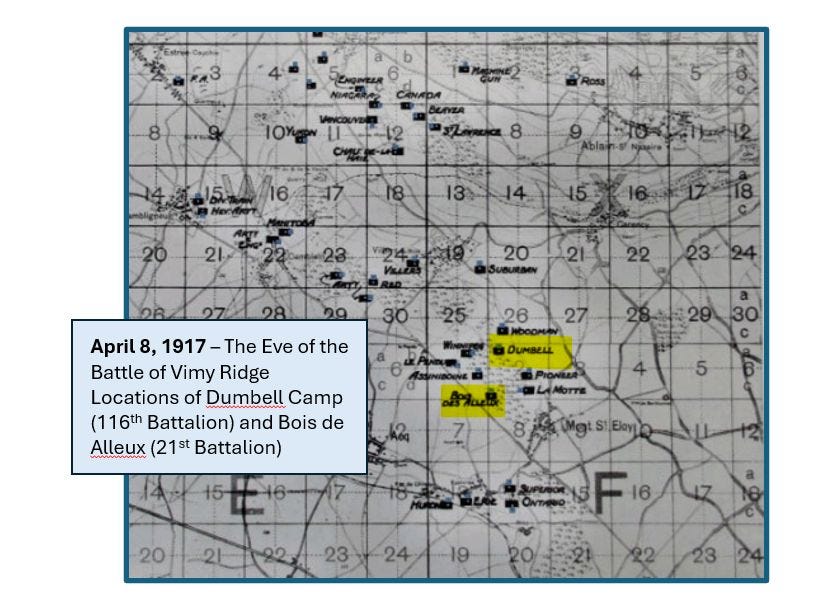
We cannot prove it took place. No records exist that document the event if they ever did. All evidence vanished when the last of the two brothers passed away. However, it did happen. It must have happened. On that day or night, on the eve of the greatest battle in Canadian history, the two brothers met somewhere between the camps to wish each other well and potentially say their final goodbye. The two brothers grew up solely dependent upon each other…for companionship, support, relief, trust. They experienced separation far too often, sometimes by choice, more often by the unfortunate circumstances of their condition. Who sought out whom on that storied night? One can only guess. Charles, filled with concern and care for his younger sibling, upon learning that his brother’s unit, the 116th was close could have walked the short trek through the wood to seek him out. He knew what he was in for and needed to see his kid brother, one last time. Or it could have been Tommy, knowing that the 21st Battalion were only on the other side of the wood, less than one hundred and fifty yards away, requested permission to find him.
The two men were soldiers of the Great War. Private Thomas “Tommy” George Crewe who served with the 116th Battalion and his older brother Private Charles William Crewe who fought with the 21st. We can reimagine them wading through the crowds of nervous, anxious men, in the early hours of dusk and inquiring those they met for the location of a particular company or platoon. We can see their eyes, struggling to see through the chaos, listening attentively, seeking, searching for the sound of a familiar voice. And we can visualize how they felt when they were finally united…relief, comfort, joy, unease. A warm handshake. Warm. Loving. Maybe followed by a comforting hug…one of the ones that linger. The final connection…eye to eye, cementing the final memory in each of their minds before they break and turn away, retracing their steps back to their respective units propelled only by the unearned confidence of the feeling that “all will be well” resonating in their minds. Did it happen? It happened.
Sixteen years prior…
A stark wind whipped across the lush green fields of their Guernsey island home when with a brutal blast, the two youngsters, were, unceremoniously introduced to the merciless nature of the age of industrial capitalism. The year was 1901 and the Crewe brothers just lost their second parent, their mother passing away five years prior. And on that cool crude morning, the boys presided over the interment of their father, Charles Crewe. Charles and Tommy said their final tearful goodbyes and just like that became wards of the state.
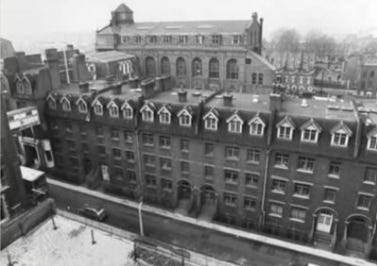
From their island home in Guernsey, the next bed the Crewe boys slept in was at a Barnardos Boys Home. Founded by John Thomas Barnardos in 1866, Barnardos Homes took in poor, destitute children from the streets and farms of late-Victorian England and provided them a place to sleep, food to eat while training them to work and survive in the real world. The story of British Home Children represents an under-told story of Canada’s story. Between the years 1880 and 1930, philanthropic organizations in Britain sent 100,000 children to Canada. Dr. Barnardos organization was responsible for thirty-five percent of this outstanding number. This group included children as young as 2-3 up to the age of eighteen. Each child has their own unique story, yet most were similar in theme and fashion. Contemporary Britain did not have the social safety nets enjoyed by our modern-day society. Because of this, parents from meager means felt they could not give their children a chance at a prosperous life. They believed that organizations like Barnardos could offer them one in the colonies leading them to simply give them their children. Others came from the squalid streets and alleyways of Industrial Britain while others transferred to Barnardos from the workhouses. They were transported to Canada, Australia, or New Zealand and placed in the households of strangers. For Canada, boys first went to a facility in Toronto for processing while girls went to Peterborough. (other locations included Quebec, Western Canada and Nova Scotia and New Brunswick in the East) Once processed, they were assigned to a home or on a farm and mandated to work as an indentured servants for no pay. Hence, in exchange for a roof over their heads, food to eat and access to an education and religious service, 100,000 youngsters became unpaid labour working in the fields or in the kitchens and households of Canadian families.
While they did not leave any surviving memoirs of diaries of their time of servitude, both Crewe boys worked as farm hands in Central Ontario. Home Children remained together during transport but often separated when posted to a home or a farm. Charles William worked as a farmhand in Palgrave, ON and Thomas “Tommy” George to a farm in Oro Township, close to the lakeside town of Orillia. This period of their lives spent in servitude was an experience shared by tens of thousands of other young children. The typical Barnardo child was between ten and twelve or thirteen years old when they were first taken in. While the receiving families were responsible for their care, they were not treated in the same fashion as an adopted child. Rather, they were considered as the property of the receiving household and treated the same as they would a new cow or goat. Memoirs or diaries that survived their time with the organization (including that of the author’s great-grandmother) often detailed both physical and sexual abuse. It is also important to note that they did not live in the ‘comfy’ confines of the houses of their ‘adopted’ families, rather housed in barns or servant’s quarters…right beside the horses, cows, and chickens.
There is a upside to the story of Home Children. The children were saved from the dire prospect of living a short, brutal destitute life on the dirty, grimy streets of London, Birmingham, or Manchester. While gaining their freedom once they reached the age of eighteen, they grew up in a safe, secure, clean, and plentiful society. They had ready access to schools and religious or spiritual support. Canada was also a vibrant, rapidly industrializing society that granted every citizen the opportunity to work, thrive and one day prosper as successful citizens.
Based on the considerable number of British Home Children transported to Canada in the early years of the twentieth century, by the summer and fall of 1915 many were of fighting age. Thus, the same patriotic nationalistic waves that swept through England and Scotland soon reached the cities, villages, and farms of Canada and caught up thousands of Barnardos Children in the wave of patriotism. In total 6211 boys brought over to Canada with the Barnardos organization serving with Canada in the war. 531 of these young men paid the ultimate sacrifice for their service. This story tells the tale of two Barnardos brothers…one who came home and one who did not.
Private Charles William Crewe – the Elder One
On the 4th of December 1915, Charles Crewe made his mark. He placed the letter X on his attestation papers and agreed to join the Canadian Expeditionary Forces. At the age of twenty-six, he was now a proud member of the Brampton-based 126th Peel Battalion. We should take note that Charles Crewe still did not know how to read or write. Instead of receiving an education as a promised condition of his servitude, Charles spent all his early years working on a farm tending to the farmers crops and livestock as an unpaid labourer. When he reached the age of eighteen, he stayed a farm hand and continued to work on farms. When he decided to become a soldier, worked on a farm in Palgrave, ON. Note that more in depth research on his early days remain outstanding. It is unclear what farm or farms he worked at while as a young Barnardos child.
The 126th Battalion trained at Camp Borden and disembarked to England in late summer, arriving in Liverpool on Aug 24th aboard the Empress of Britain. The unit experienced the same fate as so many others. Soon after reaching camp, their companies were assigned to other units. Some joined front-line fighting units, while others joined battalions training for later stages of the war. This was Charles’s fate, joining the 116th Battalion in October 1916. His transfer did not last long as on December 23rd, he was reassigned to the 21st Eastern Ontario Battalion.
The 21st Battalion, also known as the Princess of Wales Own Battalion, fought with the 4th Brigade in the Second Canadian Division. They headquarters were in Kingston, Ontario and first included men from the towns, farms, and villages of Eastern Ontario. Their battle honours started with Mount Sorrel in June 1915 and continued through the Somme and all key battles through 1917 and 1918. Approximately 25% the men, or one in four who served, were killed or died of wounds. Thus, when Private Charles Crewe joined the 21st, he was a ‘replacement’ soldier, helping restore the strength of the unit after incurring losses from the battles, raids, and front-line fighting. The next battle the battalion fought in was the Battle of Vimy Ridge.
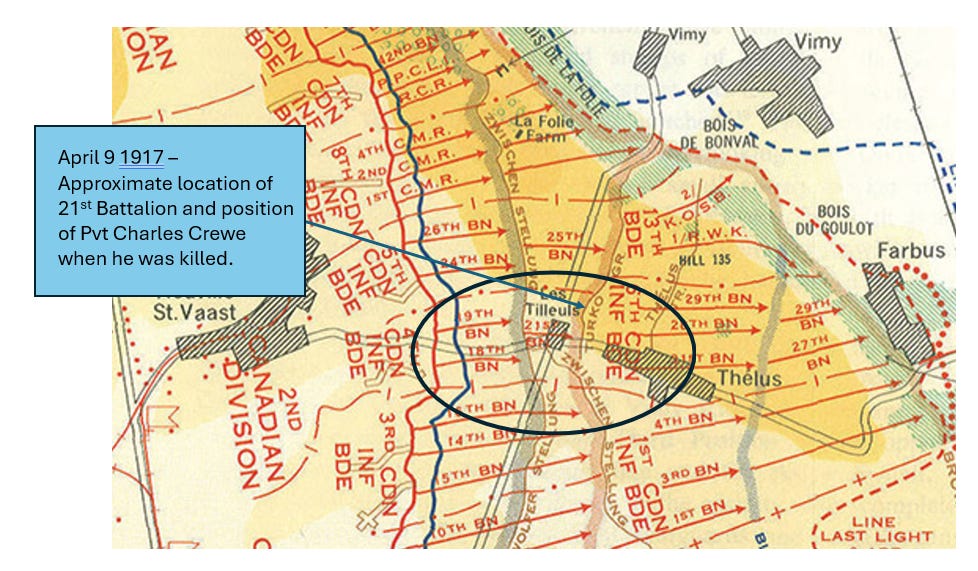
This soldier biography will not go into detail on the story of the Canadians at Vimy, rather will explain Private Charles Crewe’s war record and how the movements of the 21st Battalion relate to his eventual fate. The 21st Battalion served alongside the 18th, 19th and 20th Battalions. The 18th included men from South-western Ontario. The 19th consisted of men primarily from Hamilton and Toronto and the 20th Battalion recruited men from across Ontario but headquartered in Toronto. On the opening day of the attack, the plans had these units advancing up the far right-hand flank of the Canadian sector. This sector included fighting up the ridge towards and through the ruined villages of Les Tilleuls and Thelus. The main attack plan called for the participating units to advance towards three separate lines. The first objective was the Black Line, followed up by the Red Line and finally the Blue Line. These benchmarks stretched the length of the seven-kilometer-long battlefront and included units from all four Canadian Divisions. In the sector assigned to the 2nd Division, 4th Brigade, the 18th, and 19th Battalions led the attack. At Zero hour, the plan was for the guns to stagger their targeting using in a ‘creeping barrage’ tactic. It was beneath this progressively advancing canopy where the leading units would take the first objective, the Black Line. The plan called for the 21st to follow in close pursuit behind the 18th and 19th and once they successfully met their objective would pass through and move on to take the second objective, the Red Line. The fourth battalion participating in the attack was the 20th Battalion. They were called a ‘detached force.’ This did not mean that the unit was help back in reserve, rather was assigned to target specific objectives on the battlefield. They advanced towards two specific locations, Coppice Wood and Philip Crater. These objectives included entrenched machine gun nests, dugouts and broken terrain requiring special attention.
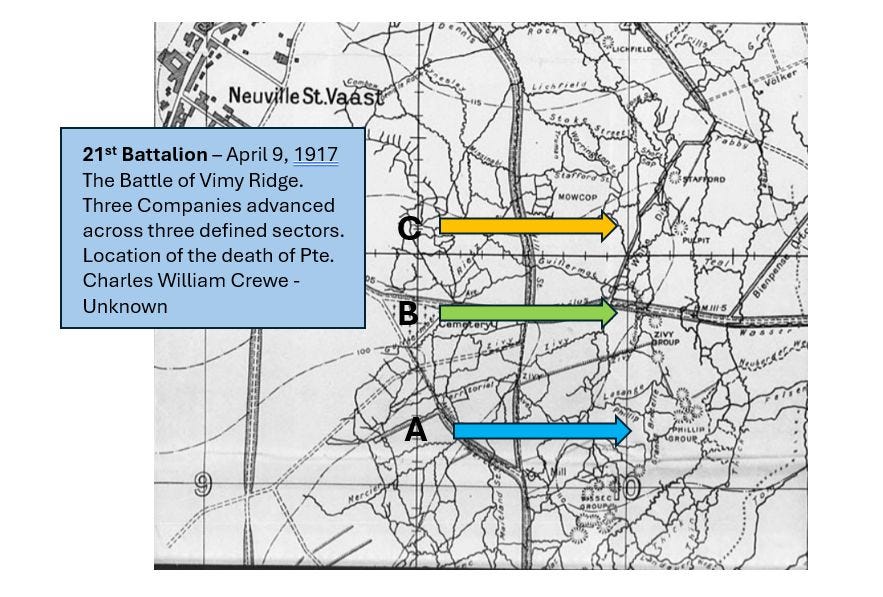
In the hours after the ‘meeting’ between Charles and Tommy, the 21st battalion began their 5 km trek from Bois de Alleux to their assigned jumping off position, a newly dug trench situated just east of the Main Street Trench. Just over seven hundred officers and men, huddled shoulder to shoulder, in the cold and the wet and waited. Zero was 5:30am. At this exact time, the gun teams shook the earth with one of the largest displays of firepower ever expressed in warfare. Immediately the men of the 18th and 19th Battalions fanned out across the front moving towards The Black Line. The 21st, following in close pursuit leap-frogged over the leading units and proceeded to the left and around the village of Les Tilleuls. The Red Line was directly to the east and represented the second objective. It was during this approach where most of the casualties inflicted by the 21st Battalion occurred. A series of entrenched machine guns and mobile trench mortar platoons, not destroyed by the initial artillery fire levied significant losses on Crewe’s unit.
This is the most amount of information we have available on the loss of Private Charles Crewe. His casualty record details that near the village of Thelus, he was struck down by enemy machine gun bullets. As his body was not recovered, these details cannot be collaborated. There is a good chance that surviving members of his platoon relayed this information along to their Sergeant and onto the Battalion Adjutant, however we will never truly know. What is certain is that in the hours and days following the attack, while the Canadians were celebrating their well-earned victory, word slowly and progressively passed along from man to man, unit to unit informing Tommy that his brother Charles counted amongst the missing.
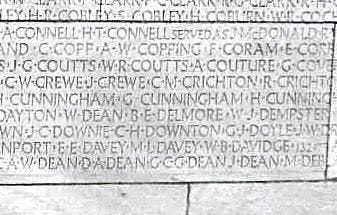
Private Charles William Crewe is remembered on both the National Canadian Memorial at Vimy and the cenotaph located in Bolton, Ontario.
Pte Thomas “Tommy” George Crewe – the Younger
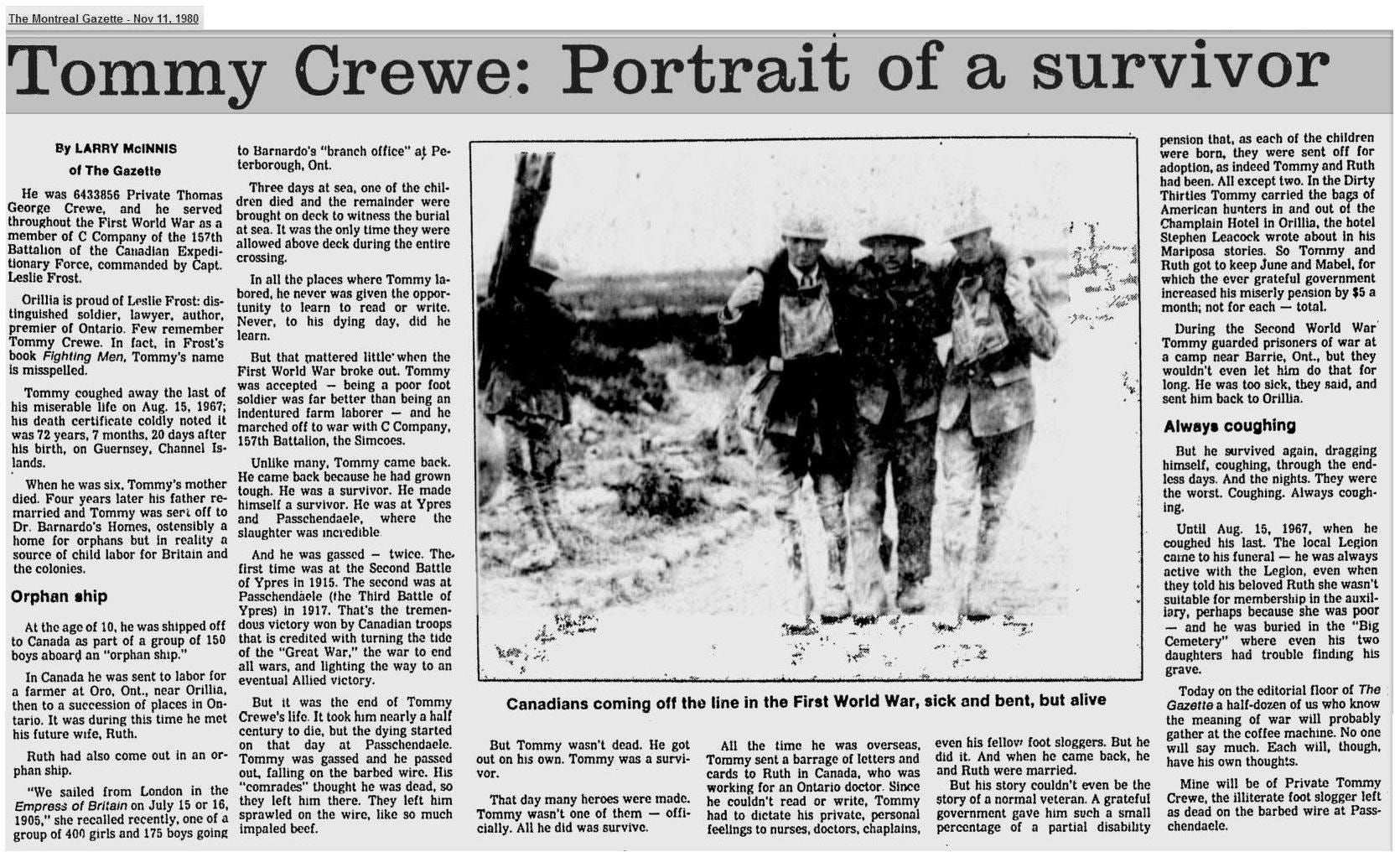
The article described him as being “sprawled out on the wire…so much like impaled beef” and left for dead. It is an adage almost impossible to fathom, but students of Great War history have heard many references to it similar in nature. The battlefields were that inexplicably evil, demented, and deranged. And for a boy who lost so much and gave so much more, to be caught in a razor wire net and left as enemy target practice or food for the multitude of vermin is difficult to appreciate. Yet, it did happen and he somehow managed to or someone helped extricate him from this deathly predicament at Passchendaele allowing him to live another day…another 18,188 days to be precise.
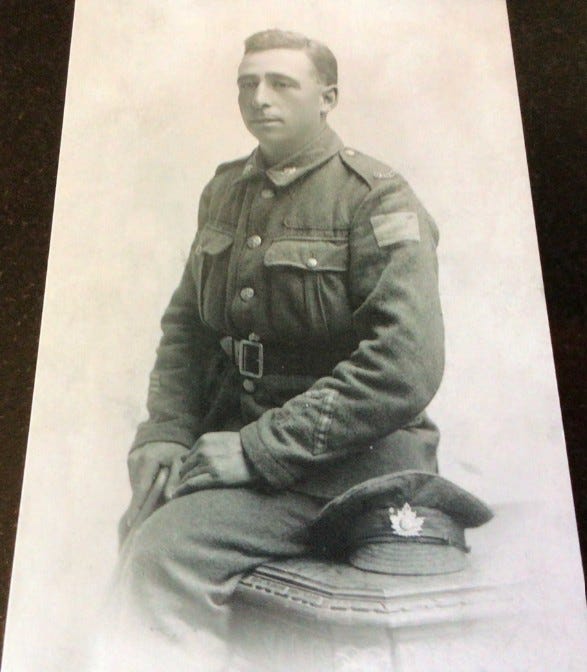
Private Tommy Crewe was born two years after Charles. He was only four years old when his mother died and barely ten when he became an orphan. As described, both he and Charles became wards of the Barnardos Home for Boys in London before being sent to Canada to work as indentured labourers. That sentence is hard to comprehend. Most ten-year-old boys today like getting tucked into bed by their mommies and daddies, read storybooks or revel in their favorite pastime, cuddling up on the couch with their siblings and a bowl of popcorn to watch Marvel movies. That would have been nice. Instead, Tommy was just labour fueling the industrial engine of the late Victorian era.
The information on the life of Tommy Crewe is much more detailed than his late brother. Despite the serious damage inflicted by the gas on his lungs at Passchendaele, he lived to the age of seventy-six. Tommy never did learn how to read or write. The record shows that while Charles worked on farms in the area north of Brampton, Tommy shuffled from farm-to-farm across Oro Township. He enlisted for the war in the dead of winter, signing up with the 157th Simcoe Foresters on Jan 25th, 1916. His story differs from that of his brother in one key facet…Tommy decided to get married. On Sept 6th, 1916, six weeks before deployment to England, he wed his fellow ‘Barnardos child’ sweetheart, Ruth May Williams. Ruth was two years his junior, was born in Wales and abandoned to the Barnardos organization by her parents. She served as a house maid in a household in Orillia.
The 157th Simcoe Foresters arrived in Liverpool on Oct 28th, 1916. The battalion was disbanded soon after their arrival with its’ members reassigned to other units already fighting in France or those still training in England. It was at this time where he came into some fortune. On Dec 6th 1916, Tommy joined the 116th Battalion, the same unit as his brother Charles. However, this reunion only lasted three weeks as Charles joined the 21st just two days before Christmas 1916.
As a member of the 116th on the 9th of April 1917, Tommy watched from a distance as his brother and thousands of Canadians took the ridge. The 116th moved forward to assist that evening, helping to consolidate the gains won by the leading units. Their role was to dig new trenches, extending those at the Canadian front line up to the German front line. This arduous task continued over the course of the next few days and continued into the Spring building new trench systems, repairing roads, and laying wire for communication purposes. In the months that followed, Tommy survived the full battalion raid at Avion on July 23rd, 1917, and the vicious, hard fighting conducted at Lens in the Battle of Hill 70. His family history recalls that he was twice gassed. Based on his medical records, his first introduction to the noxious weapon was in the battle of Hill 70…however there is a chance he was also exposed to it at Avion. The medical record affirms the story told in the Montreal Gazette newspaper article from Nov 11th, 1980. He was gassed in the Battle of Passchendaele and treated at the casualty clearing station on the 28th of October 1917.
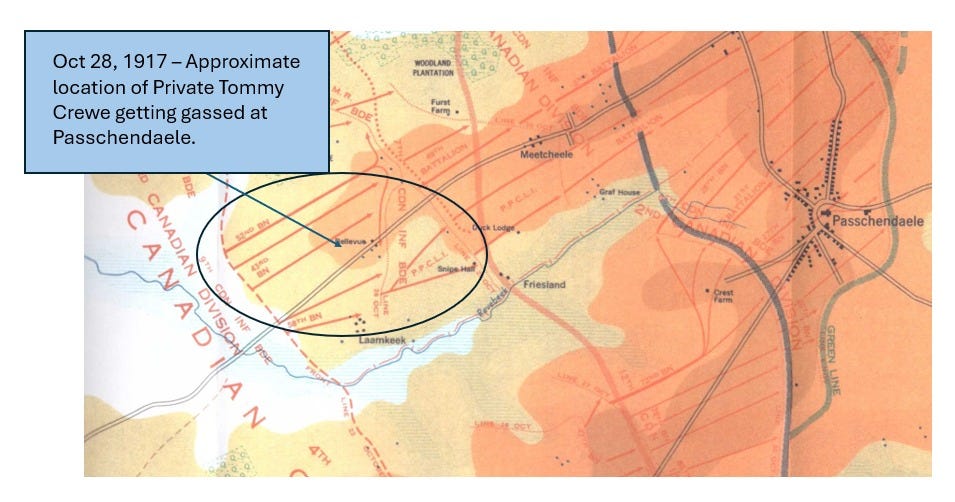
On the 28th of October, the 116th Battalion moved forward to relieve the tired and bloodied 43rd, 52nd and 58th Battalions. Those units led the assault on Bellevue Heights and Abraham Heights in the Battle of Passchendaele. Most casualties happened in the initial phase of the Canadian offensive. When the 116th moved forward into relief, they held the line until the next phase began on the 30th of October. Revisiting the image portrayed in the opening paragraph, it was in the callous inhumane conditions where Tommy fell or collapsed from poison gas into a net of barbed wire. A combination of utter exhaustion from three sleepless days and nights and then the gas must have contributed to his dire situation. Thankfully, however, he survived the ordeal, sent back to England and recovered in hospital. With that injury, the war for Tommy was over.
Tommy made it home to Canada and returned to the arms of his lovely bride Ruth. The two communicated regularly throughout the war with Tommy regularly sending back messages to his wife. This reveals another aspect of his most interesting life as Tommy, being an uneducated indentured farm labourer and never learning how to read or write, was still able to maintain a continuous stream of correspondence with Ruth. Tommy asked everyone from his fellow-battalion mates to his chaplain to nurses and doctors to write his notes while he dictated the messages to them. If these notes survived, it could reveal so much more about the characters and lives of the two individuals. Tommy and Ruth had seven children, two dying at or near childbirth. However, as all exceptional stories have their twists and turns, with Tommy still suffering from his corroded lungs the couple were forced to put three of their own five surviving children up for adoption, a fate both well understood and tragically shared by the couple.
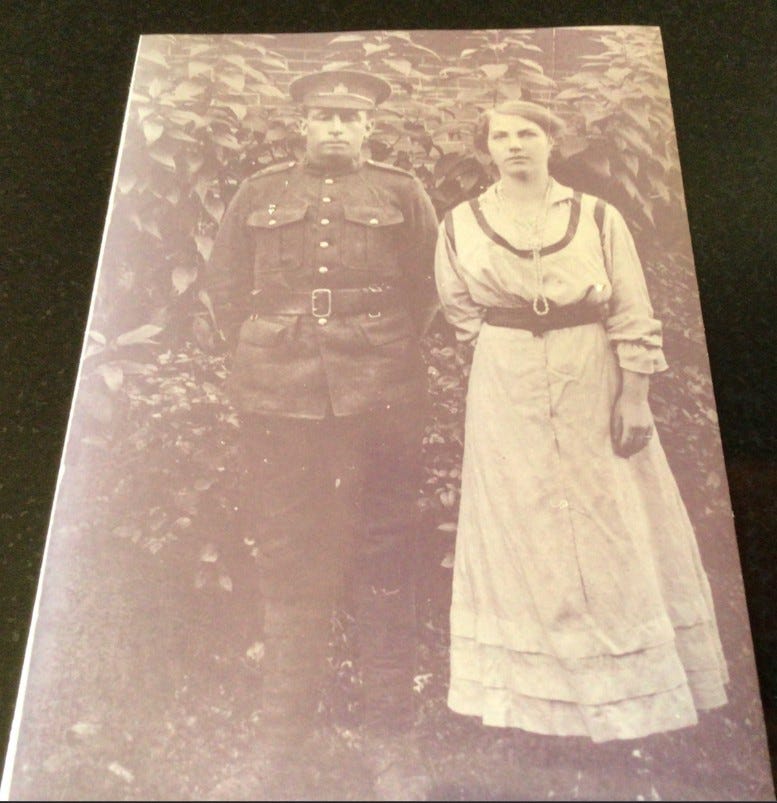
Tommy’s service to his country continued in the Second World War where he, along with this hacking cough, guarded prisoners at a POW camp near Barrie, ON. He was active in the community a long-time member of the Legion. Tommy died on Aug 24, 1967 in his adopted hometown of Orillia Ontario. From the British isle of Guernsey off the coast of France to orphanages to Canada care of Dr. Barnardos organization, Tommy Crewe lived a consequential life. For a man who could still only write an X for this name, the mark of a man comes from the legacy their leave and from the impacts they have on the lives of others while living. The last chapter in his life was written soon after he passed away. A ceremony held in town saw the full membership of Royal Canadian Legion along with many, many townsfolks come out to say their final goodbyes to their auld soldier, the orphan, Private Tommy Crewe.